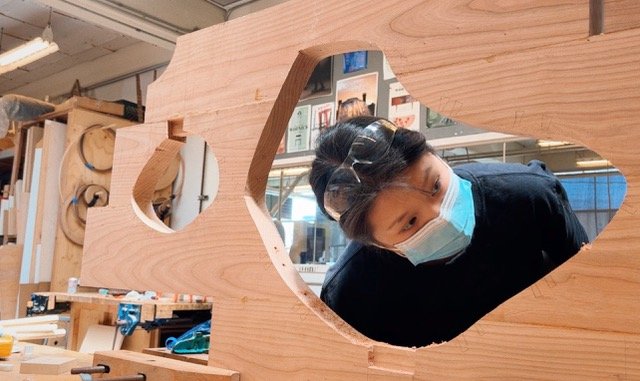
The yin and yang of film is commercially marketed blockbuster versus high-concept art film. Neither can exist on its own without the eventual dissolution of the artform. While it might be deficient in a surplus of financial REI, the more artistically bent part of this equation makes up for it in the admiration and praise of peers. Art director Yuanyuan Zheng is familiar with this concept as she makes a conscious effort to invest her impressive skill in productions which expand the boundaries of what is being created in present day to inspire and delight herself and others. The credo of many present-day filmmakers is, “Make what you want to see.” Considering this notion, the mind of Ms. Zheng is a place of visual complexity and fantasy that provokes emotional catharsis. More than most, Yuanyuan understands how the visual surroundings we are immersed in can completely alter our perception of situations and people. Communicating how she places a bit of herself in all her productions, she states, “The environment in which an Art Director grows up naturally imprints itself onto their visual language—just as you can often see a director’s personal experiences reflected in their work. While an Art Director is responsible for constructing a world for the characters, their imagination is always rooted in their own knowledge, memories, and cultural influences. Elements such as the texture of architecture, the color palettes of natural landscapes, the way climate affects lighting, and the storytelling traditions of their culture subtly shapes how they perceive and build visual narratives. Additionally, the production styles and working conditions of different national film industries can significantly impact the way Art Directors develop their craft.”
Through her role as the art director on the 2023 film Adagio, Yuanyuan was given the opportunity to flex her creativity to an extensive degree. The story follows the main character Avery as she vacillates between reality and a fantasy world in this semi-lucid state, the audience is tethered to her emotional condition through the powerful and fascinating visual language established. Reality, illusions, and memories combine leaving Avery (and thereby, the viewer) to question what is real. Yuanyuan describes her approach for this film as that of creating private spaces for Avery, where her fragmented memories could exist. There is a fragility of maintaining these spaces but they are too intoxicating to relinquish. The tepid state of confusion is a major strength of this film’s ability in allowing the audience to inhabit Avery’s emotional space. Ms. Zheng confirms, “One of the biggest challenges I faced while working on this film was distinguishing between hallucination and reality within the script itself. The film’s poetic nature deliberately avoids giving the audience a clear distinction between what is real and what is imagined, making it just as difficult for me as the Art Director to navigate these transitions. As I read through the script, I often found myself struggling to determine which scenes were hallucinations and which were grounded in reality, which in turn influenced my approach to set design and visual storytelling.” The profundity of Ms. Zheng’s cues throughout this film can only be appreciated through multiple viewings. For example, the lilly which burns on the shore in the final scene is a cue to a foundational relationship for Avery and this lilly can be found in multiple scenes throughout the story. This is only one example of the intricate design Yuanyuan has sparsed throughout this incredible film. Adagio was recognized on an international stage. It was an official selection of the 77th Salerno International Film Festival and the 19th San Francisco Frozen Film Festival in addition to receiving a nomination from the 8th Mediterranean Film Festival (Cannes-Milan-Athens).
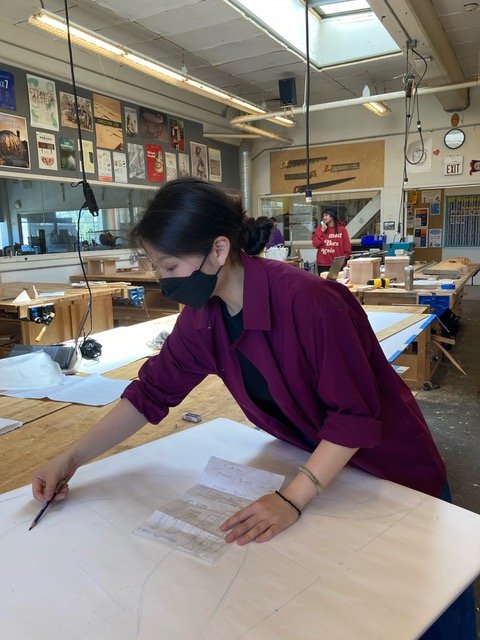
While awards are beneficial to reinforcing confidence, Yuanyuan stipulates that the best part of Adagio’s notoriety is the fact that it led other filmmakers to her. Producer Weiming Wang notes that Ms. Zheng’s work on Adagio communicated an ability to craft visually immersive spaces that blend poetic symbolism with narrative depth; exactly what was desired for Wang’s next production Love to Phallus. This avant-garde film blends surrealism with philosophical themes of human desire and identity. An official selection of the European Short Awards which received awards from events such as the Indie Short Fest and others, Love to Phallus is presented with a distinctive visual style, utilizing bold colors and sculptural set pieces to manifest the protagonist’s psychological state. Longing for intimacy while he’s been trained to conceal his emotions, the main character’s desire to experience more with someone whom he has just come into contact with ascends to an all-consuming state. Through Yuanyuan’s art direction, the blurring of reality and fantasy again (as with Adagio) becomes transferred to the viewer. While there are numerous examples of this, Ms. Zheng finds some of the simplest ones to be the most gratifying. She describes, “I find that the exploration of the character’s inner state leads me to the right tools, just as it would with an actor. There’s a scene near the very end of the film where John (the man he has come into contact with) feeds our main character Yang a peach. This sharing of food is far more than what it seems on the surface. Not only does it evoke sensuality, intimacy, and temptation, but it also carries deep literary and cultural symbolism. In many artistic traditions, the peach is associated with fleeting beauty, desire, and a moment of indulgence, all of which align with Yang’s internal conflict and the fragile dynamic between him and John. The act of John offering Yang a peach, gently feeding it to him, felt like the perfect metaphor for their growing attraction—a gesture both intimate and restrained, inviting yet uncertain.” Communication is the source of every relationship. Throughout the many films on which she’s served as art director, Yuanyuan Zheng establishes that she is a master of using the world and its surroundings to communicate the internal messages we conceal from ourselves and others. It’s clear and captivating. We need only watch and feel to receive it.
Writer : Basil Thomson
 Ayushi Saini