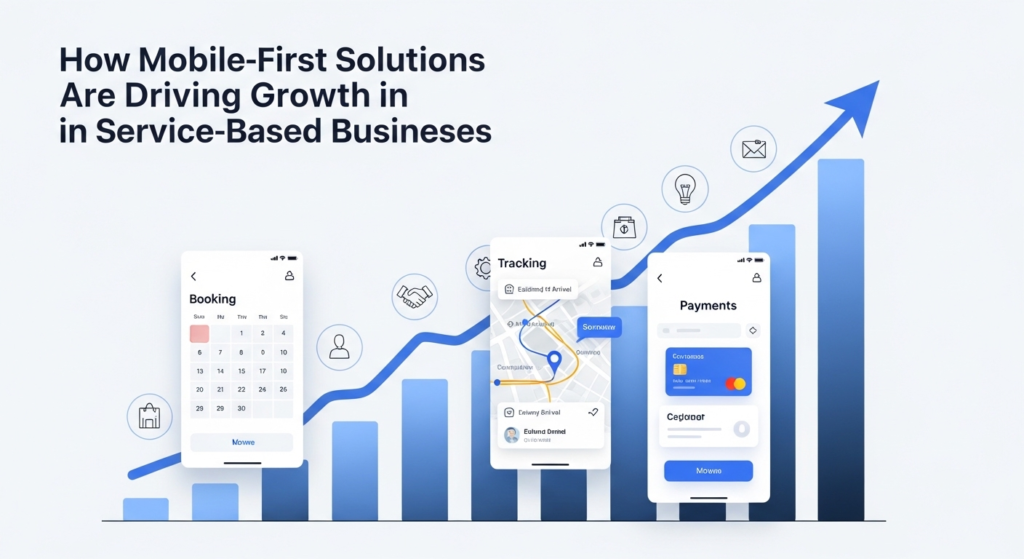
To be frank, there has been a total transformation in the methods that consumers use to locate, book, and engage with service providers. Regardless of if the company offering this type of service is cleaning, plumbing, doing logistics, transporting goods using an on-demand fuel delivery service – if your consumer is unable to access, track or pay you via their mobile phone in less than two minutes, chances are they are engaging with a competitor who provides access to your good or service on their mobile device.
This is not hyperbole; this is the reality of today’s society, and it’s why mobile devices have become the preferred access point for purchasing just about every type of service. Companies that have capitalized on this have experienced exponential growth because they were nimble or innovative enough to adapt to this new way of accessing services.
In this article, I’ll highlight exactly how mobile-first solutions are driving measurable growth for service-based businesses and clarify what having a “mobile-first” strategy really means beyond simply having a mobile app.
First, What Does “Mobile-First” Actually Mean?
Businesses often misunderstand what mobile-friendly versus mobile-first actually means. To clarify, mobile-friendly describes designing an existing website/system to be usable via a smaller display. Mobile-first refers to designing the entire customer experience and internal processes to be mobile-friendly from inception through all subsequent development efforts.
To illustrate, consider the difference between the two types of booking pages. The mobile-friendly page might work with a mobile device, but still won’t function as quickly (is non-intuitive) or be designed to be “thumb pocket friendly” (vs. “mouse / 27-inch screen friendly”) versus a mobile-first page.
This is particularly important for service-related businesses. Customers on the go require fast service. Field personnel are typically also working from remote locations in vehicles. Even dispatchers (call center agents) work from both a tablet and/or a phone. Creating a clunky user experience may not be an issue when it is only an afterthought; however, having a clunky operation as an afterthought creates a more cumbersome overall process versus creating a smooth operation as the foundation.
Faster Customer Acquisition — Because Friction Kills Conversions
When searching for a business/service using your smartphone, how did that process go? You probably found the service, clicked the link, and then determined within about 10 seconds whether or not to continue exploring the offering. That’s the window of opportunity that mobile service businesses have. If a consumer arrives at your site on their phone, has to pinch/zoom, waits for a slow site to load, or hunts for the phone number in a small text area, they will leave; it’s that simple.
Businesses that are built for the mobile marketplace focus on removing any friction from the visit. They offer Instant Booking with a couple of taps; one-click-to-call; GPS-based service area detection; and mobile payment options, which enable curious visitors to become confirmed customers in less than 10 minutes.
Google’s research consistently demonstrates that a one-second delay in loading a page on a mobile device can decrease conversion rates by up to 20%. Service businesses that improved the mobile experience have seen conversion rates increase by approximately 30 – 50%, due to making it easier to say, “Yes, I want your services”, because they are using their phones!
Smarter Field Operations Through Mobile Workforce Tools
Moving to a mobile-first approach can have a considerable impact on growth: not just by attracting new customers but also by giving customers an improved experience without overworking the team or increasing headcount.
How do we know this? Mobile workforce management technologies have revolutionized how field service teams do their jobs. Today, technicians, drivers, and on-site staff can do their jobs with everything they need in their pockets:
- Job assignments and routes in real time,
- Customer information and history notes,
- Digital checklists and photos,
- Instant status updates to dispatch,
- Mobile invoices and immediate payment collection.
Before the development of mobile workforce management tools, dispatchers managed all the things listed above using phone calls, handwritten paper logbooks, and Excel spreadsheet records. Each time an update was received (e.g., a new job assignment, serving a customer), it required calling the dispatcher. When each job was completed, paperwork had to be done. When a route needed to change, there would usually be confusion about which driver would go where.
Today, a dispatcher can monitor up to 6 drivers in real-time; reroute 2 based on current traffic conditions; give an updated ETA to the customer; and close out 3 different jobs. all without having to make a single phone call. The level of improvement to the operations of a business that this represents is absolutely significant. It’s also the sort of improvement that allows a business to double the service it offers without doubling the size of the workforce.
Real-Time Tracking Builds the Trust That Keeps Customers Coming Back
One thing that often gets overlooked in conversations about mobile-first growth is the trust factor. Service businesses live and die by repeat customers and referrals, and one of the biggest drivers of both is whether customers feel informed and in control.
Think about what happened before real-time tracking. You called a plumber, they gave you a four-hour window, and you sat around the house waiting. You had no idea if they were ten minutes away or two hours away. You called the office. They called the technician. Someone got back to you eventually.
Mobile-first platforms have completely transformed this experience. Customers now get a live map showing exactly where their service provider is and an accurate ETA that updates in real time. They don’t have to wonder. Customers don’t have to call anyone. They just check their phone.
This is especially powerful in industries where timing is critical. Consider fuel delivery as an example, customers who need a refill at a specific time can’t afford uncertainty. When they can track their delivery in real time and know it’ll arrive within a precise window, that reliability becomes the reason they keep using the same provider. Businesses in sectors like this have published detailed guides on how dispatch and tracking technology works behind the scenes. A good example can be found in this fuel delivery dispatch software guide, which illustrates just how much the customer experience depends on mobile-connected logistics working smoothly in the background.
Customer satisfaction scores consistently climb when real-time tracking is introduced. More importantly, so do rebooking rates. When people feel looked after, they come back.
Data That Actually Helps You Run a Better Business
Most service businesses do not really realize the extent of data they will have once they embrace a mobile-first strategy until they go mobile-first.
Using mobile platforms to manage all your customer interactions, job completions, route data, and payment records will provide you with an incredibly powerful picture of your business. You will know which jobs are taking longer than expected and why; you’ll know which drivers are the most productive and how they are getting to their destinations; and you’ll know which customers order from you regularly and which ones are no longer buying from you.
Building this kind of operational visibility is extremely difficult when you are managing your business with spreadsheets, phone calls, and paper records. Most of the data that mobile platforms generate is the result of everyday business operations, meaning you will not have to do anything additional to generate this data.
The companies that are leveraging this data to their advantage have a true competitive advantage. They can forecast demand, proactively manage their staffing levels, proactively address any possible bottlenecks, and personalize their customer communications so they do not come across as “generic.”
The On-Demand Economy Has Raised the Bar — For Everyone
There is a second dimension to this dialogue, which ought to be communicated openly. Customer expectations have been reset, and they have been permanently set according to companies like Uber, Doodah, and Amazon. Customers now expect an ability to book a service or get a meal delivered to them instantly, track their delivery in real-time, digitally pay for the service, and receive a notification that the delivery has been completed. Customers expect these options for food deliveries, ride-sharing, and now also for service deliveries, such as plumbing, cleaning, electrical, and fuel services.
Service businesses which are meeting their customers’ expectations are not simply maintaining the status quo; rather, they are creating competitive advantages over their competitors who have yet to abandon their antiquated operational processes. In markets where the delivered services are almost identical, the customer’s experience is typically what will drive their purchasing decision.
According to a recent 2023 survey by Salesforce, 88% of customers stated that the experience provided by a business is as important as the actual product/service that they provide to customers. Therefore, for service-oriented businesses, the customer experience increasingly exists/existed on the customer’s mobile device.
Scalability Without the Growing Pains
The mobile-first approach has an underrated benefit- the ease with which scalability occurs. Traditional service businesses are often hindered by their inability to grow due to the overall amount of phone calls, paperwork, coordination headaches, etc., when adding additional customers; eventually, there is a point when the operations cannot keep up with the demand.
Mobile-first systems are built for scalability; adding a driver, technician, or service area does not require a restructure of your workflow, and routing will instead adjust automatically, and the profiles of new customers will automatically fit into the existing profiles that you have. With regard to notifications, they will be automatically sent out without anyone needing to trigger them manually.
The result of this is that you will see many small and medium service businesses aggressively growing at a higher rate than was previously possible due to the platform taking over a lot of the coordination work that used to be done by human resources.
What a Mobile-First Transformation Actually Looks Like
Many business owners may think of making this shift in their business model, but it does not mean that moving to a mobile-first strategy has to be done all at once. Most successful transitions follow a consistent pattern:
- Customer touchpoints should come first. Make it easy for your customers to locate you, schedule appointments, and pay via their phone. Just making this one change will impact conversions greatly.
- Connect your field employees to the mobile world. Provide your technicians or drivers with mobile devices to help them manage jobs, provide status updates, and document work performed. This will cause your coordination costs to drop dramatically overnight.
- Connect your back office to the mobile solution. Ensure that your scheduling, invoicing, and customer relationship management tools work seamlessly together on your mobile platform. This will reduce manual data entry.
- Leverage your data. Once you have a mobile platform in place, use the data you collect to improve your operational decisions.
Businesses that take the time to follow this systematic process, rather than attempting a complete transition all at once, will likely see results sooner and stay committed to the process longer.
The Bottom Line
Waiting out the mobile-first trend is not an option. It represents a fundamental change in service industry operations and competition; as time goes on, the divide between those who have adopted mobility into their business functions and those who have not continues to widen.
The companies that are thriving at present, creating repeat customers, increasing size without corresponding expense increases, and consistently outperforming competitors, do not have the best product on paper. They have the best customer experience through every interaction, easy, fast, and transparent.
Your customer currently holds this advantage in their palm.
About the Author Bio:

Name: Anil Patel
Create our account with
Email: anil.nectarbits@gmail.com (Connected with Gravatar)
USER ID: anilhpatel
Website: https://nectarbits.com
LinkedIn: https://www.linkedin.com/in/ani2nil/
As a Digital Marketing and Content Strategist Planner at NectarBits, A Leading Software Development Company in the USA and a SaaS small business Solution in Canada, I am effectively behind the company’s content strategy, copywriting, brand communication, and operations. My prime focus is Content Marketing and ROI. I love writing and sharing knowledge. On weekends, I enjoy watching Tom and Jerry cartoons on TV.
 Ayushi Saini