Unexpected equipment failures not only disrupt business but also have a cascading effect on production schedules, safety, customer commitments, and profitability. In asset-intensive industries such as manufacturing, energy, logistics, and utilities, assets play a vital role. In these sectors, an unplanned shutdown can result in losses of thousands or even millions of dollars per hour. This is happening in organizations that continue to rely on maintenance practices that are reactive or follow a rigid schedule that is not aligned with equipment condition.
This is precisely where predictive analytics solutions using artificial intelligence are breaking the rules. Rather than making educated guesses about when machines might go down, companies can now forecast problems before they happen. Thanks to the use of AI/ML solutions and Predictive Maintenance AI solutions. Through this approach, teams are moving from firefighting to a proactive reliability approach.
Why Traditional Maintenance Can’t Keep Up?
The classical types of maintenance models are divided into two categories:
- Reactive maintenance: Equipment is fixed after the failure. This causes unexpected downtimes, hazards and increased repair expenses.
- Preventive maintenance: Maintenance is planned at regular time slots, irrespective of the equipment condition. Although an improvement over reactive strategies, it usually leads to excessive maintenance and unwarranted replacement of parts.
Maintenance is planned at regular time slots, irrespective of the equipment condition. Although an improvement over reactive strategies, it usually leads to excessive maintenance and unwarranted replacement of parts.
How AI-Powered Predictive Maintenance Actually Works?
AI-powered solutions, which constantly analyze the equipment behavior, are at the core of predictive maintenance. These systems drag in information across a variety of sources – IoT sensors, machine logs, SCADA systems, maintenance records and operational metrics. This is aimed at developing a living model of asset health.
Here’s how it plays out in practice:
- Continuous data collection: Vibration, temperature, pressure, acoustic, power consumption and runtime data are recorded by the sensors.
- Pattern learning: AI/ML solutions learn what “normal” looks like for each machine and operating condition.
- Anomaly detection: The system identifies subtle deviations which are missed by humans.
- Failure prediction: Models estimate the likelihood and timeframe of component failure.
- Actionable recommendations: Maintenance teams receive alerts and prioritized work orders before breakdowns occur.
Teams receive early warning and adequate lead time to organize interventions rather than respond to alarms once a machine is no longer functioning.
The Real Business Value of Predictive Maintenance
The benefits of organizations using predictive analytics solutions are much greater than reduced breakdowns:
- Reduced unplanned downtime: Early detection prevents catastrophic failures.
- Lower maintenance costs: Repairs are targeted, avoiding unnecessary part replacements.
- Longer asset life: The equipment operates in the optimum operating ranges.
- Better planning: Maintenance windows align with production schedules.
- Improved safety: Reduced occurrences of surprise failures minimize the hazards at the workplace.
Over time, predictive maintenance transforms maintenance teams from a support function into a strategic force that drives uptime and profitability.
The Technology Stack Behind Predictive Maintenance
Predictive maintenance is not a one-tool solution, it is an environment of technologies working in unison:
- Industrial IoT: Real-time machine health data is being sent through sensors and connected devices.
- AI & Machine Learning: Models learn patterns and predict failures.
- Cloud & Edge Computing: Enable real-time processing and scalable analytics.
- Advanced Analytics Platforms: Turn raw data into dashboards, alerts, and insights.
- Integration with CMMS/EAM: The predictions are sent straight to the maintenance processes.
These components can be applied collectively to create a feedback mechanism in which each maintenance process enhances future forecasts.
Predictive Maintenance vs Traditional Maintenance
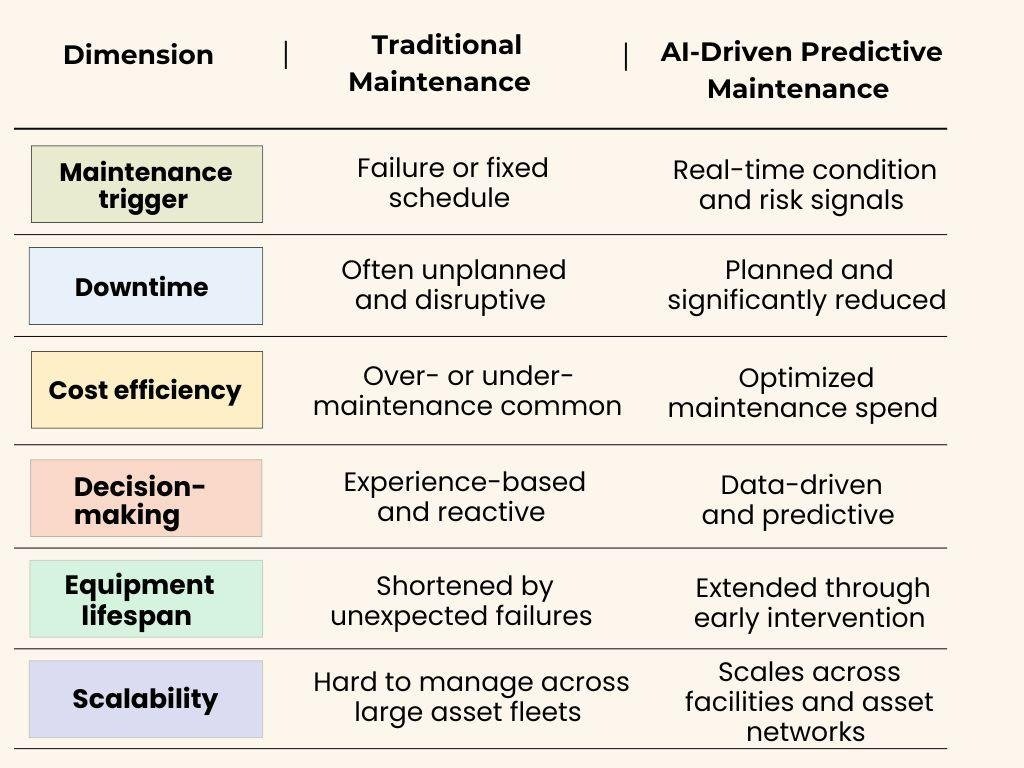
This analogy demonstrates why Predictive maintenance AI solutions are taking modern operations as a norm.
Industry Use Cases: Where Predictive Maintenance Delivers Value
1. Manufacturing
Early indications of bearing wear, motor imbalance and anomalies in the production lines are identified by AI models and allow avoidance of expensive line stoppage.
2. Energy & Utilities
Predictive analytics anticipate transformer failures and turbine degradation, reducing outages, and improving grid reliability.
3. Transportation & Logistics
Fleet managers track the performance of the engines and the components to eliminate the downtime of services and to increase the life of the vehicle.
4. Oil & Gas
AI detects corrosion, pressure variations, and fatigue of equipment in difficult conditions, minimizing the risks of safety and downtimes.
In these industries, machine learning AI applications work with large volumes of data, which in any case cannot be processed by humans with the necessary speed and precision.
Getting Started: A Practical Adoption Roadmap
Implementing predictive maintenance doesn’t have to be overwhelming. A phased approach works best:
- Begin with high-risk assets that generate the most downtime when they fail.
- Instrument equipment with sensors and connect existing data sources.
- Run pilot projects to validate value and refine models.
- Be integrated with current systems such as CMMS, ERP and IoT systems.
- Train teams to trust and act on predictive insights.
- Scale gradually across plants and asset fleets.
The trick is to treat predictive maintenance as an ongoing process rather than a project.
Common Challenges and How to Overcome Them
However, adoption of this highly effective technology will still not work if organizations overlook the following challenges:
- Data quality: Poor sensor placement or noisy data can limit accuracy. Start small and improve data pipelines over time.
- Change management: Maintenance teams may resist AI recommendations. Involve them early and show quick wins.
- Integration complexity: The integration with legacy systems should be carefully planned.
- Skill gaps: Pair domain experts with data scientists to ensure models reflect real-world conditions.
If these issues are taken care of, organizations will be able to realize faster time-to-value and sustainable outcomes.
From Predictive to Prescriptive: The Next Frontier
With the maturity of the Predictive Analytics Solutions, organizations can shift towards prescriptive maintenance. This implies that AI does not only identify failures but it suggests the best course of action, when to take action and the amount of resources to use. For example, systems can recommend fixing an issue immediately or deferring maintenance. They can also advise replacing a part during a planned shutdown to minimize cost and disruption.
This change makes maintenance a highly optimized decision-support capability that balances the risk, cost and uptime on a continuous basis.
Concluding Thoughts
Operational downtime is no longer a necessary cost of doing business. Organizations are able to predict failures rather than respond to them with the Predictive maintenance AI solutions. With AI/ML solutions along with real-time sensor information and embedded workflows, the maintenance can be proactive, strategic, and value-based.
The path forward is clear: adopt AI-powered solutions, integrate predictive analytics with existing monitoring and IoT systems, and build a culture of proactive maintenance. The organizations that do so nowadays will not only minimize their downtime but will be creating stronger, more efficient, and resilient operations in the future.
 Punit
Punit  Ayushi Saini