The automotive body repair has come to a critical crossroads in 2026. With changes in vehicle substrates toward complex alloys of aluminium and ultra-high strength steels (UHSS). There is an increasing trend of the replacement of the traditional hammer and dolly processes by integrated technological centers called the Ausbeulstation (Dent Removal Station).
These are full package stations of rectifying the car bodies, which will take a combination of electrical induction, pneumatic pullers, and micro-welding technology to provide high-velocity and affordable car body rectification.
In the case of workshop owners and automotive technicians, having an idea of the mechanical and electrical complexity of an Ausbeulstation is the key to a competitive advantage in the era of Smart Repair (Small to Medium Area Repair Technology).
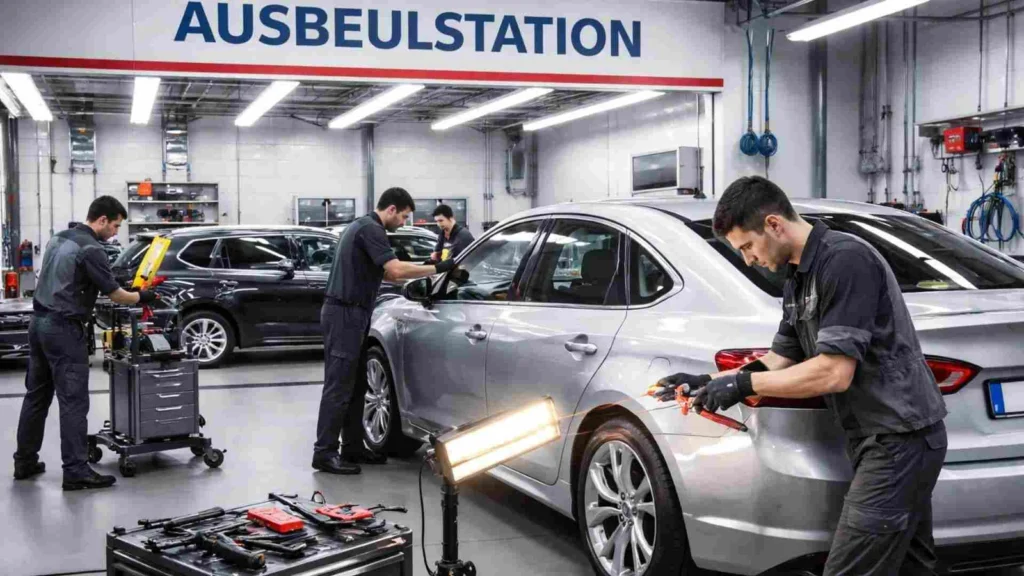
The Core Architecture of a Modern Ausbeulstation
An Ausbeulstation, of professional grade, is not a single tool, but a mobile, integrated workstation that can be used to make the different steps involved in the de-denting process without the need to actually access the inside of the body panel. This philosophy of repairing the exterior is what makes it unique compared to legacy.
1. The Central Unit: The Spotter
The Spotter (or stud welder) is at the center of any Ausbeulstation. This technology uses resistance welding in a unit that is based on a transformer or inverter to temporarily fuse copper-coated bits of steel, corrugated wires or washers to the surface of the dent. High-frequency inverter spotters are favored in 2026, as they can control even the heat needed to prevent the burn-through of thin modern panels and the anti-corrosion coating on the back of the metal.
2. The Pulling Elements
After the welding pieces have been connected, the technician uses numerous pulling tools:
- Slide Hammers: These are used to pull deep structural dents aggressively.
- Lever Pullers (Dellenlifter): When smaller indentations are to be lifted accurately and with precision.
- Bridge Pullers: Using a bridge puller across the entire width of the damage, applied to a considerable area of the surface, is best when dealing with long creases or hail.
The Technical Workflow: From Analysis to Rectification
The effectiveness of an Ausbeulstation service lies in its technical workflow, which is standardized. The Ausbeulstation is used on the outside instead of the inside, unlike conventional solutions that mandate removing the interior trim of the vehicle to force a dent out of it.
Phase I: Surface Preparation and Tension Analysis
The paint has to be washed off in the immediate area of impact before any mechanical work is done so that the spotter can conduct electricity. Contemporary stations can also have special sanding attachments, which restrict the area of removal to the barest minimum. After being stripped, the technician then examines with a PDR Light (Paintless Dent Removal light), or a grid board, the tension lines of the dent. It is important to understand the crowned areas or high areas on a dent, and unless the tension is released properly, the metal will merely draw up into its deformed form.
Phase II: Resistance Spot Welding
The technician picks the right attachment – generally a triangular washer or a threaded stud – and the gun of the spotter is used to make it weld to the lowest position of the dent. The required amperage and welding time are typically automatically computed on the basis of the panel thickness (e.g. 0.6mm up to 1.0mm) chosen by the user by the software of the Ausbeulstation.
Phase III: Progressive Traction
The technician exerts an outward force with the help of a lever-like puller. This is aimed at pushing the metal a little further than in its actual plane as a way of taking into consideration the natural elasticity of the metal. In the same phase, the technician can tap the tension ridges surrounding the part with a finishing hammer; that is, the molecules of the steel are basically relaxing, allowing them to accept the new position, which is flat.
Advanced Substrates: Handling Aluminium with specialised Ausbeulstationen
The repair of aluminium panels is one of the biggest technical obstacles in 2026. Aluminium is much lower in shape memory than steel and is an even better conductor of heat, and therefore, traditional welding is not easy.
Capacitor Discharge (CD) welding is used in a specialized Aluminum Ausbeulstation. The welding of aluminium studs (usually AlMg3 or AlSi12) can be accomplished using this technology without harm to the surrounding metal. Since aluminium gets hard almost instantly, an induction heater or a hot air blower is also present in the station.
Heating the panel to about 200 o C to 300 o C also increases the ductility of the aluminum, and a permanent repair can be made, which would break the panel permanently otherwise in the event of trying it cold.
Economic Efficiency: Why Ausbeulstation Services are Affordable
Reduced labour hours and material costs do not just transform the so-called Affordable Care Act in dent repair into a mere marketing buzzword.
- Elimination of Disassembly: When traditionally working on a part, door cards, airbags and electronics may be removed to reach the rear of a panel. This may increase by 2-4 labor hours for an easy job. This is removed completely by the Ausbeulstation.
- Minimised Filler Usage: Since the Ausbeulstation reforms the metal almost 95-98 per cent of its original form, a mere micro-layer of body filler is necessary. This will avoid future problems such as shrinkage or cracking of filler.
- Reduced Paint Area: The technician is able to typically do a “Spot Repair” or “Fade-out” instead of painting an entire side of a car.
Integrated AI and Digital Precision in 2026
The latest series of Ausbeulstationen that are in use in professional workshops in 2026 include AI-assisted operation. These computer stations have laser-scanning sensors to scan the depth of the dent in microns.
The system will then overlay a heat-map onto a digital screen for the technician, showing:
- Optimal Welding Points: The places to locate the washers to make the greatest leverage.
- Pulling Pressure Limits: The technician should be warned in case the force to be applied is most likely to surpass the tensile strength of the metal to avoid tearing.
- Material Identification: The sensors which identify whether the panel is steel, galvanized steel or aluminium automatically are based on the electricity parameters of the spotter unit.
Safety and Compliance Standards
There are high standards of technical safety in using an Ausbeulstation. The process is associated with high-amperage electrical currents:
- Electronic Safety: To prevent frying of the On-Board Diagnostics (OBD) and Engine Control Units (ECU) of the vehicle, modern stations are fitted with surge protection, which is needed to handle the resistance welding process.
- Ergonomics: The workstations are made in such a way that they make a mobile trolley with a well-organized tool layout to decrease technician fatigue and enhance the “Tact-Time” of the repair.
Conclusion: The Future of Car Body In standsetzung
The Ausbeulstation has turned the car body repair into a high-precision science as opposed to a brute force craft. These services provide a form of compromise between the high costs of replacing panels and doing low-quality cosmetic repairs, using the principles of resistance welding, pneumatic traction, and thermal dynamics.
To the consumer, it translates to a car that has managed to maintain the structural integrity and original factory finish at a fraction of the conventional price. In the case of the workshop, it is a high-efficiency source of revenue, which maximizes throughput. With the current development of vehicle materials, the Ausbeulstation proves to be the most versatile and technically viable option for performing current dent repair.
 Ayushi Saini