Augmented Reality in Education is becoming an important technology in modern Educational institutions. AR allows students to interact with digital objects placed within the real environment through smartphones, tablets, or AR headsets. This approach changes how learners explore complex subjects, visualize abstract concepts, and engage with educational content.
Educational institutions and EdTech startups are increasingly exploring AR-based solutions to improve engagement and learning outcomes. Implementing these systems often requires collaboration with an experienced educational app development company that understands how to build scalable digital learning platforms and integrate immersive technologies into existing educational ecosystems.
Unlike traditional learning materials, augmented reality introduces visual and interactive elements that help students better understand difficult topics. When learners interact with 3D objects, simulations, and dynamic models, they process information faster and remember it longer.
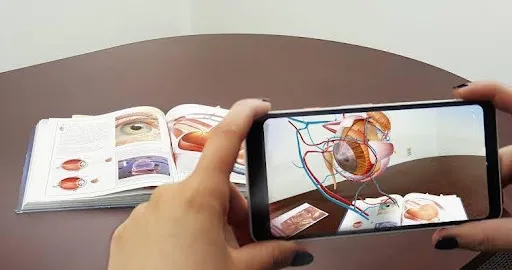
AR technology also helps educators demonstrate processes that would otherwise be impossible to show in a classroom environment. Students can explore historical landmarks, study the internal structure of the human body, or analyze scientific experiments without needing expensive equipment or travel.
Why Augmented Reality Is Becoming Important in Education
Today’s learners desire an interactive and visually stimulating learning environment. Traditional (static textbook and lecture only methods) can become challenging to hold learners’ interest particularly in more technical topics.
Using Augmented Reality (AR) enables learners to have an enhanced level of immersion while providing more opportunities for active/experiential learning by allowing students to engage with concepts rather than simply reading about a concept. This shift in how students engage with concepts will result in improved comprehension/understanding, motivation, and willingness to explore further.
Loss of accessibility – In general, AR applications work on mobile devices such as smartphones and tablets which allows for the use of AR in educational settings, while at the same time does not require the purchase of expensive hardware infrastructure to create AR experiences.
As educational digital learning platforms continue to evolve, we find that the use of Augmented Reality (AR) technology is quickly becoming a staple within the modern Education Technology (EdTech) ecosystem.
Practical Use Cases of Augmented Reality in Education
Augmented reality supports many educational scenarios across schools, universities, and corporate learning environments.
1. Interactive science and biology lessons
Students can use AR to help visualize complex biological structures. Using AR capabilities, students will be able to look at 3-dimensional models of organs, cells, and body systems. Rather than looking at a static picture or diagram, students will able to rotate objects, zoom in on parts, and see how 2 or more systems interact with one another.
With such an interactive experience, students will gain a greater understanding of anatomy, chemistry reactions and physics experiments.
2. Medical training simulations
Medical education necessitates hands-on training that typically cannot be replicated easily and safely inside a classroom setting and augmented reality provides an opportunity for students to practice procedures through the use of realistic digital models in a simulated environment. The future doctor can study how to perform surgical procedures; examine the internal structures of the body; and explore different types of patients without endangering any of them.
3. Engineering and technical training
AR visualization has a lot of advantages for students in engineering programs. Students will be able to view things like equipment, mechanical systems and structures with multiple digital layers overlaid on top of each other.
AR simulations give learners the ability to see how things work internally, experiment with structural designs and learn how complicated systems operate.
4. Virtual historical exploration
Typically, history classes provide students with information by way of text and/or pictures. However, augmented reality enables students to learn about history by experiencing even further past through virtual experiences of historic sites.
With augmented reality, students can explore the immersive environment of ancient buildings, battlefields, or archaeological sites right from their classroom. This type of immersive experience gives the student a greater connection between the past and the present.
5. Interactive field trips
Virtual field trips using augmented reality (AR) provide students the means to virtually visit different parts of the world by taking them from a location within a classroom to places like museums, cultural landmarks, and ecosystems through digital overlays that supply contextual data and visual detail about the destination otherwise inaccessible. Through this approach, students have more access to learning and at a lower cost than if they had traveled to see something in-person.
Benefits of Augmented Reality for Learning Platforms
The use of augmented reality in modern education systems has numerous benefits.
One advantage of AR is that it increases student participation by making lessons more dynamic through the use of interactive visual content. Students are more likely to be engaged in their learning when they are using AR technology; therefore, they will tend to participate more.
By interacting with an object rather than just reading about it through a textbook or online resource, students gain a better understanding of the topic and form stronger long-term memories related to the subject matter.
AR also allows for student-specific adjustments to the educational material, ensuring that students can progress through the educational curriculum at their own pace. This personalization enhances each student’s ability to learn the educational material to the fullest extent possible.
Educational institutions can also utilize valuable data and analytics gained from AR systems will provide educators with valuable insights into how students utilize AR technology, which will allow educators to identify areas where a student is struggling and make appropriate changes to improve the student’s educational experience.
Key Steps to Implement Augmented Reality in Education
Successful AR integration requires careful planning and technical expertise. Educational organizations should follow several key steps when implementing augmented reality systems.
1. Define clear learning objectives
The initial stage is recognizing places AR can provide true worth to the learning experience. Since not every lesson calls for using virtual reality, we should concentrate on those lessons that would enhance understanding of subject matter through simulations or visualizations.
2. Select appropriate technology frameworks
Development frameworks (like ARKit, ARCore, or WebAR technologies) are often used as the foundation for building AR applications. With these technologies, developers can create interactive experiences that can be utilized on more than one device and ensure that they are compatible with pre-existing hardware and software.
3. Integrate AR with existing learning platforms
A lot of schools and universities already have a learning management system in place, so they should connect AR experiences to those systems so that students can access the use of immersive lessons directly within their course environment.
This integration allows teachers to track their student’s learning and create a seamless ecosystem for their students’ education.
4. Develop intuitive user experiences
AR programs need to be simple for both students and educators to use. If it is too complicated then the learning process is reduced through reduced exposure. Simple interactions, easy to understand instructions and clear navigation through the AR environment have to be central to the design of AR applications.
5. Provide training for educators
For successful usage of technology by teachers, there needs to be support and training in the implementation of AR technologies in their classroom practices. Training on the appropriate usage of AR will help ensure that these technologies are used as supporting tools to facilitate learning rather than furthering their use as an added novelty.
Challenges of Using Augmented Reality in Education
Even though there are benefits to using augmented reality, there are still many challenges that come with working in this field.
Creating content for an AR application is one of the biggest hurdles. To create a good-quality 3D experience in AR will require technology development skills or the technical ability to build digital content using software developed with these capabilities.
The second challenge is making sure an AR application can work across multiple devices. Many mobile devices will be compatible with AR applications; however, those applications may not offer equal levels of performance across all devices.
Educational institutions must have safeguards in place to ensure that data collected by learning analytics programs as well as the data collected from students through interaction with an AR application is kept secure.
Working with qualified development teams who have previous experience with both technology and education will help drive AR project success.
The Future of Augmented Reality in Education
As technologies develop to become more reasonably priced, accessible, and integrated into mainstream society, the opportunities for augmented reality (AR) in education will continue growing rapidly.
AR technologies can be combined with other advanced technologies (greatly enhanced by artificial intelligence, data analytics, and adaptive learning models) to provide extremely immersive, personalized learning experiences across many fields.
In the near future, learners could have the chance to work with intelligent AR-based teachers/tutors, participate in fully interactive scientific simulations, and receive real-time assistance/feedback when engaging in task complexity.
Institutions that embrace the use of immersive learning technologies early will be in a much stronger position to deliver high-quality digital learning environments in the future.
Final Thoughts
AR is providing a new way for students to relate to educational materials through engaging immersive environments; while also enhancing students’ ability to grasp difficult concepts, develop real-life practical skills and maintain their interest during class time.
Schools, universities and EdTech companies need to partner with a qualified app development company that specializes in building virtual/tablet-based education apps in order to successfully implement immersive technology in their education programs and develop scalable and quality products that will provide the necessary support for future online education systems.
The developers of AR technology who implement AR technology into their education programs today will create the foundation for tomorrow’s online education.
 Ayushi Saini
  rocktabbu000786