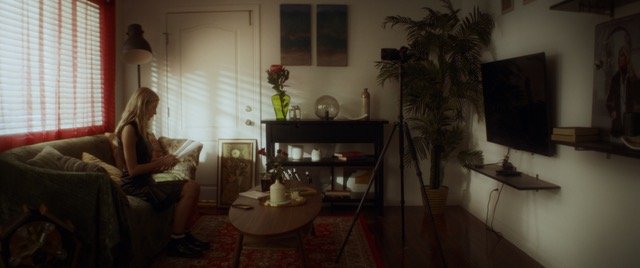
For those who find themselves tired of the superhero film genre, it’s worth one’s time to view All That Glitters is not Marigold. Director Evey Yu’s tale of a young actress whose career and life is on the verge of metamorphosis as she becomes the newest focal point in an international mega-franchise is more psychological than action while giving deep insight behind-the-scenes of this world. An official selection of multiple Oscar qualifying festivals including the LA Shorts International Film Festival and the Flickers’ Rhode Island International Film Festival, every aspect of this film is exceptional but it’s specifically the cinematography which has received so much attention. DP Shih-Hsuan Kuo has contributed a remarkable visual language to this film which has received a great deal of attention from events like the SoCal Film Awards where it was awarded Best Cinematography.
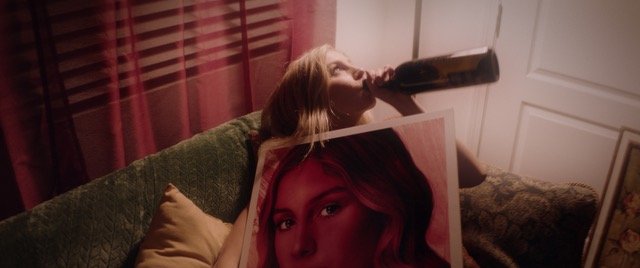
There are only a handful of people who understand what Alanna (played by Alyssa Touhy), the character at the center of this story, is undergoing. The attention, the scrutiny, the financial propulsion, all of this would be too much for any sane person but add to this Alanna’s artistic aspirations and it’s a nearly debilitating set of circumstances. Beneath her poised public image, Alanna is overwhelmed by fear, pressure, and insecurity—forces that begin to manifest physically and psychologically. As she descends into an existence that vacillates between her subconscious and reality, the actress takes on a delusionary perspective that is not clearly separated for the audience, leaving them to wonder where the delineation actually resides.
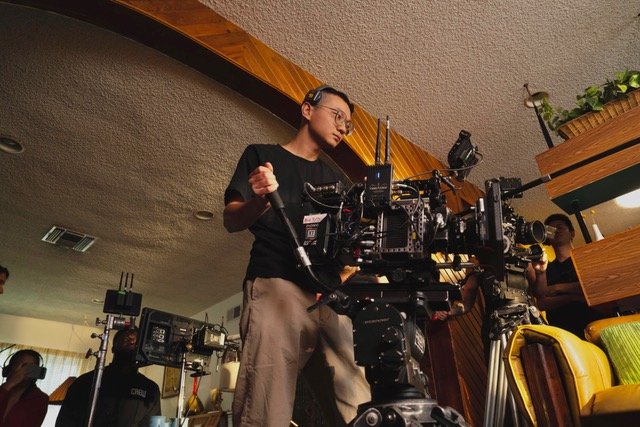
The differences between the real world and Alanna’s altered mental state are subtle early on. Once the nightmare sequences emerge, it is the visual language that allows the viewer to empathize with this actress. A lower frame rate is used to depict fear and chaos. This creates a heavy motion blur aesthetic that heightens the surreal quality of movement. The lighting as well as different elements on camera are imbued with red, a cue to Alanna’s emotional breakdown. Near the end of the film, she experiences a true breakdown and it’s again the cinematography which drives the moment. Shih-Hsuan Kuo explains, “This sequence marks the emotional peak of the film, where Alanna begins to lose her grip on reality. We used a montage structure to accelerate her psychological unraveling, capturing moments from both her waking life and nightmares. To keep the experience intimate and disorienting, we shot most of it handheld, following her movement closely as she spirals deeper into fear and confusion. The use of anamorphic lenses in this sequence was essential. The natural distortion of the lens warped the space around Alanna, visually echoing her fractured mental state. The goal was to create a deeply subjective POV, making the audience feel like they’re inside her head—never quite sure what’s real and what isn’t. This visual strategy draws inspiration from Black Swan, particularly in how it blends illusion with reality and uses erratic movement and distortion to reflect psychological collapse.” This surreal and emotionally charged confrontation between Alanna and Scott (Played by Jeff Lawless) in a red-lit room is violent and raw. The red lighting, a recurring visual motif throughout the film, returns in full force—representing danger, desire, and inner turmoil.
It’s apparent throughout the entirety of this film that the stylized and experimental visual language is inseparable from the perspective of Alanna, propelling the performance of Alyssa Touhy to achieve an even more potent impact. Cinematographer Shih-Hsuan Kuo heaps praise on director Evey Yu for what he was able to achieve on this film professing, “The most rewarding part of working on All That Glitters Is Not Marigold was the creative freedom I had to experiment visually and push the boundaries of my own cinematography style. This film gave me a rare opportunity to explore a highly subjective, psychological visual language—one that let me try bold ideas like using strobe lighting, heavy motion blur, warped spaces, and unbalanced compositions to reflect a character’s mental collapse. This film continues to be a reminder of why I love what I do: to visually translate emotion, collaborate with bold storytellers, and create experiences that linger with the audience long after the film ends.” The IndieX Film Festival showed its admiration for the look of All that Glitter is Not Marigold with a nomination for the Best Cinematography Award. During an era in which VFX seems ubiquitous, this film has found a way to deliver a very human centric story that may emerge as a subgenre of this popular theme.
Writer : Basil Thomson
 Ayushi Saini